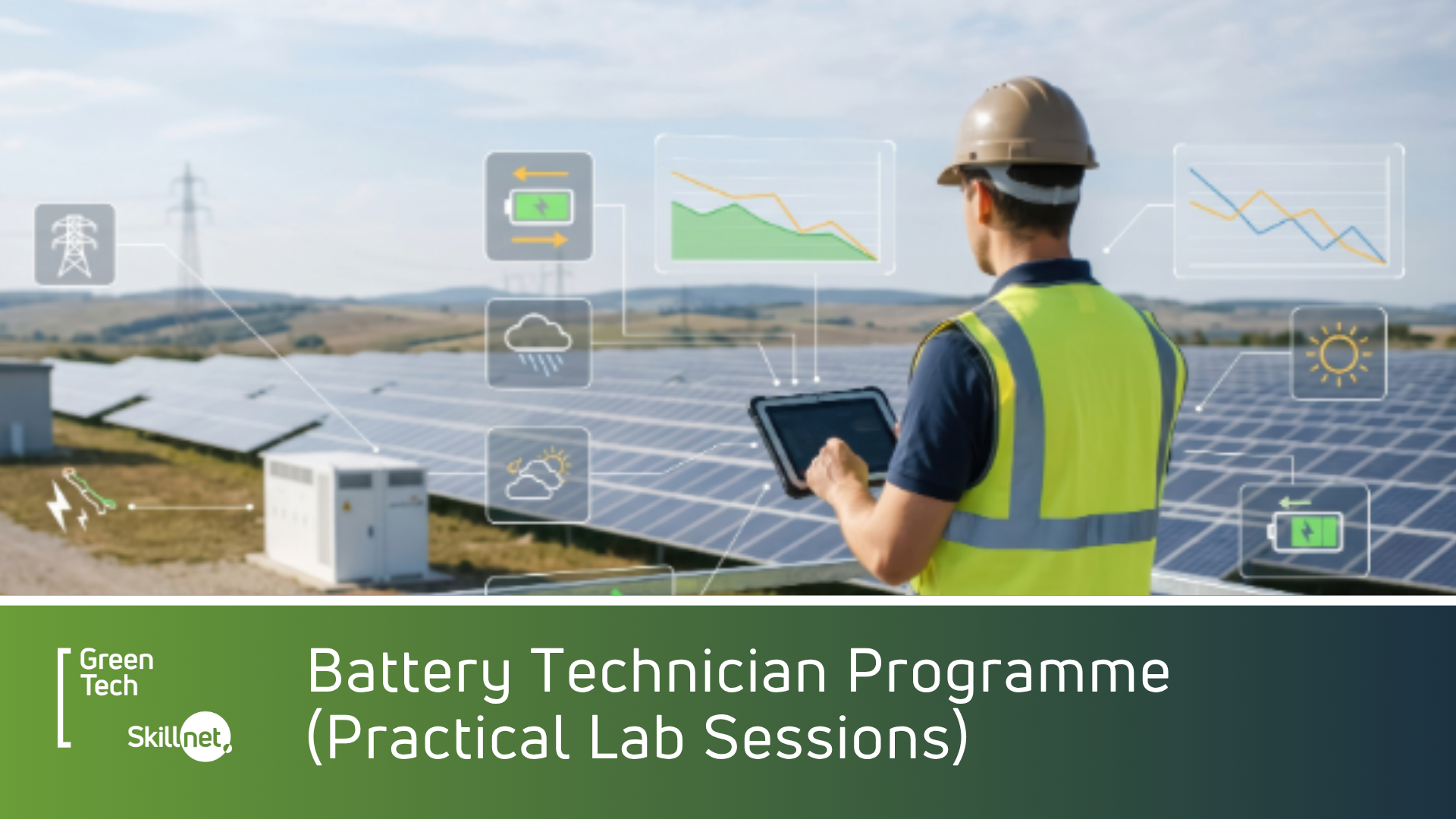




This programme is delivered in a hybrid environment, including online self-paced lessons, making it easy for participants to learn without having to take time off work, and in-person face-face lab sessions. The certification consists of eight self-paced online courses and twelve in-person face-to-face lab sessions and is structured as follows:
This certification focuses on the new skills that are needed related to designing, operating, testing, maintaining, and replacing battery cells and packs for various applications. During the training, the different types of batteries that are already relevant today can be tested in a practical lab for their specific characteristics.
The Battery Technician Programme allows participants to choose the right technology for the right challenge, set up battery systems, and evaluate battery performance. Moreover, to be able to work out a solid total solution, the Battery Management systems, the charging and maintenance of batteries and their recycling process are also discussed in more detail. Finally, sufficient attention is given to the safe handling of these electrical applications, both for the person and for the environment.
IMPORTANT: This booking page is for the Practical Lab Sessions only. Participants must complete the Online Modules before attending the lab sessions. If you have not yet completed the online modules, you can book the Complete Battery Technician Programme by clicking here, or book the Online Modules only by clicking here.
Grant funding comes from Skillnet Ireland through the Irish National Training fund, and, as a result, is ONLY available to residents of the Republic of Ireland who work as a sole trader, or for a private or semi-state commercial company registered in ROI. Please read Eligibility Criteria.
The certification consists of eight self-paced online courses and twelve in-person face-to-face lab sessions.
Online Modules: 8 online Self-paced (must be completed before the in-person lab sessions). Learn more here.
In-person Labs: 25th, 26th, and 27th of November 2026
More details in the course content tab below.
Upon completion of the certification, learners will be able to:
- Evaluate what battery technology is best suited for which application, based on its characteristics
- Analyse (dis)advantages of most used battery technologies
- Design and implement the best fit battery solution for each application
- Safely handle, test, repair, and dispose of battery systems, according to legal obligations
Lab Modules (in-person)
Day 1
Lab 1: Build your own physical battery pack
- Build a battery pack respecting all safety requirements
Lab 2: Read datasheets to create a battery pack
- Define a single cell capacity
- Find the cell capacity on a datasheet
- Find on a datasheet the discharge rate
- Make correct selection of a BMS
Lab 3: Charge, discharge, and test a battery cell
- Test a battery cell
- Charge and discharge a battery cell
- Define battery capacity
Lab 4: Handle batteries while respecting safety and regulations
- Handle and work with batteries in a safe way
Day 2
Lab 5: Stationary batteries: observing and doing
- How to discern home batteries from each other
- How a home battery interacts with a PV system
- What to consider when using a leadacid battery
- How to use a portable power battery
Lab 6: Dimension a residential PV and battery storage system
- Go through the steps of dimensioning a residential PV system
- Replicate a process for dimensioning home batteries
- Consider criteria depending on the local grid rules and tariff structure but also evaluate the influence of the consumption pattern
- Include back-up power
- Use some black-box dimensioning tools on the internet
Lab 7: Connect batteries to converters
- How to connect several home battery systems
- How to make a connection for their set-up
- How they are connected to the PV installation and residential electricity grid
Lab 8: E-bike battery charging, repairing and testing
- Do diagnostics of battery
- Find problems and faults related to a broken battery
- Repair the identified fault
Day 3
Lab 9: Charge and discharge battery pack of an e-bike
- Charge and discharge a battery pack
- Interpret a discharge curve
Lab 10: Connect to charging infrastructure
- How to connect an EV to a charger
- Identify different charging plugs and the reasons
- Discern between AC and DC charging
- Evolution in charging speed
- Expectancy on speed at residential homes
- Commercial charging formulas
- Vehicle to grid possibility and its use in smart grids
Lab 11: Smaller electrical devices and traction batteries charging, repairing and testing
- Replace cells in a battery for power tools or other small devices with a focus on the NiMh technology
Lab 12: Dismantle battery packs for recycling
-
- Dismantle a battery in a safe way and isolate cells in a module
- Remove the battery pack in a safe way out the housing
- Remove the contact strips from the cells
- Remove the cells out of the frames
All labs in the Battery Technician Programme will be conducted on the premises of Munster Technological University and will be led by university lecturers. The date and logistical details will be provided closer to the workshop date.