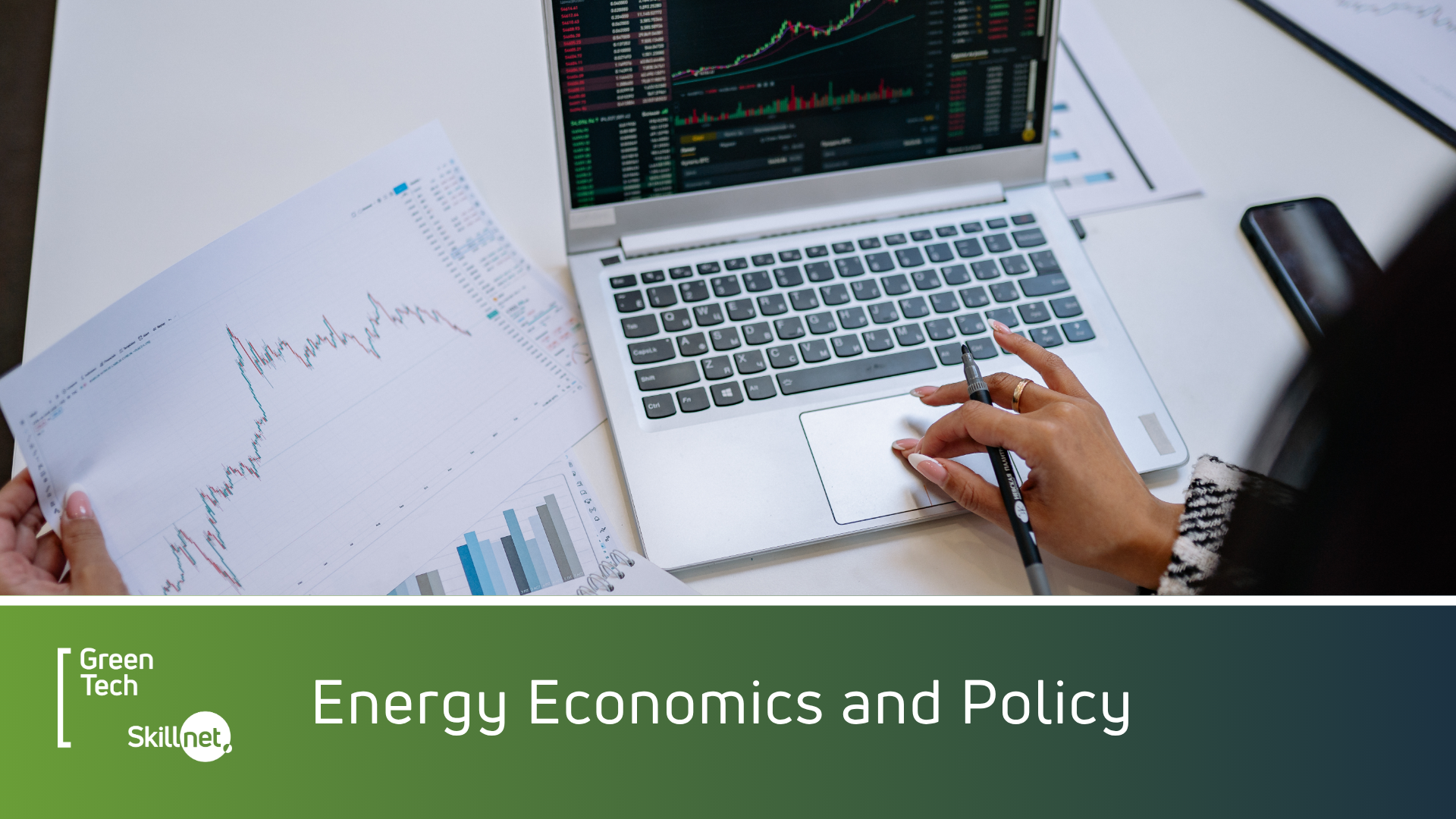



The transition towards a more efficient use of natural resources, including energy resources, is vital for meeting our existing climate goals. Commissioned by Green Tech Skillnet, Developed by University of Limerick, in partnership with Industry, the Energy Economics and Policy Micro-Credential offers a unique combination of research-led teaching and problem-based learning to provide a comprehensive understanding of the key issues influencing the future of energy sustainability.
The Micro-Credential will cover the key contemporaneous dynamics affecting energy markets from the supply and demand sides. With a strong focus on the role of public policy in shaping energy markets, the Micro-Credential will support students to develop a deep understanding of the inter-relation between economic systems, energy markets, and policy. By following a research-led approach, the Micro-Credential will enable students to develop key critical and analytical skills for assessing and discussing key debates and associated evidence, guiding existing policy responses in the energy field of energy economics. The Micro-Credential will also allow students to gain and demonstrate important practical skills, regarding the application of conceptual and empirical tools used in energy economics research.
If you want to know more about the economic, social, and environmental facets of energy markets and apply this expertise to your career, the Energy Economics and Policy Micro-Credential is perfect for you.
*** Applications are now open. Please check your eligibility below. If you are eligible, please proceed to make the payment. Once payment has been received, the registration link for UL will be sent. If you are ineligible or work for a semi-state company, please enquire now. ***
Grant funding comes from Skillnet Ireland through the Irish National Training fund, and, as a result, is ONLY available to residents of the Republic of Ireland who work as a sole trader, or for a private or semi-state commercial company registered in ROI. Please read Eligibility Criteria.
- Develop and in-depth understanding of the economic, social and environmental dynamics underpinning energy markets and energy sustainability.
- Build your knowledge and insights through international evidence in energy issues from the latest energy economics research.
- Develop critical analytical skills to assess and debate key energy economics issues.
The day/time will be agreed with the students in week 1 (the first week is already booked in advance, but the remaining weeks are decided as per the group’s availability)
| Academic Week | Topic | Lecturer | Description | |
| 1 | Introduction to Energy Economics | Dr. Mauricio Perez Alaniz | Introductory lecture focused on the inter-relationships between energy markets and the critical societal grand challenges of climate action and inclusive growth. The lecture will also highlight role of policy in forging and maintaining these inter-relations. | |
| 2 | Wholesale electricity market design | Dr. Niall Farrell | Introduces key tools to analyse energy supply using key micro-economic concepts. Discusses wholesale market structures and the economic rationale for current market designs. Contemporary issues such as the energy crisis will be discussed, alongside empirical research investigating the competitiveness of electricity markets. | |
| 3 | Electricity Demand | Dr. Niall Farrell | Introduces key tools to analyse energy demand, using the electricity as example, and the importance of guiding more efficient demand profiles through concepts such as time of use pricing. This will introduce the use of behavioural economics in the analysis of energy consumption, with discussions of some empirical research. | |
| 4 | Efficient Energy tariff design | Dr. Niall Farrell | Focused on economic concepts related to efficient tariff design, the importance of efficient tariffs in guiding sustainable behaviour, and the trade-off between efficiency and equity in tariff design. This will be related to contemporary Irish policy decision-making in this space. | |
| 5 | Public Policy and Renewable Energy | Dr. Niall Farrell | This topic will analyse the most commonly used policy instruments used by governments to incentivise renewable energy deployment. The issue of managing investor and consumer exposure to market price risk will also be discussed, and insight into how this may influence mechanism choice. This will be related to empirical literature and contemporary developments in international energy markets. | |
| 6 | New Technologies and Energy Sustainability | Dr. Muireann Lynch | The topic will focus on the role of innovative technologies in advancing energy markets and climate action. The lecture will discuss existing technological trends in energy markets, the increasing pressure on this market related to climate change, and the associated economic impacts. | |
| 7 | Key Challenges affecting a Green Energy Transition | Dr. Muireann Lynch | With a specific focus on the energy sector, this lecture will analyse the key challenges affecting a green energy transition, including green energy investments, high-costs, lack of skills, etc. | |
| 8 | Policies for Driving the Green Transition in Energy Markets | Dr. Muireann Lynch | Building on the lectures in Weeks 6 and 7, this lecture will analyse the key policy instruments used in Ireland (and elsewhere) to enable overcoming existing barriers to a green energy transition, and thus help accelerating the process of technological change in the energy sector. | |
| 9 | The European Energy Market and social and environmental issues | Dr. Kinga Tchorzewska | This lecture will discuss the European energy market and its trends. It will also focus on the key concepts of energy poverty and energy sustainability, and analyses of existing evidence on these topics. Finally, it will highlight the importance of energy markets for environmental and social issues, at the European level. | |
| 10 | Firms, technology and the energy transition in Europe | Dr. Kinga Tchorzewska | The lecture will cover the role that firms play in driving the generation and adoption of modern technologies for energy efficiency. It will discuss market failures affecting these activities, and the rationale for public policy. | |
| 11 | The environmental and energy policy instrument mix | Dr. Kinga Tchorzewska | Building on the previous week, this lecture will present the concept of Environmental and Energy Policy Mix for driving energy efficiency and green technologies. It will also introduce key empirical tools for analysing the impact of such policy mixes, and discusses the existing evidence on this topic. | |
| 12 | Conclusion | Dr. Mauricio Perez Alaniz | This will provide a critical review of the material covered in the previous weeks, and generate some key overarching conclusions. | |
Professionals working in the energy sector who want to develop skills in energy economics and energy sustainability as part of a professional development path. Graduates seeking to work in the energy sector and interested in developing an in-depth understanding of the critical inter-relationships between energy markets and social and environmental issues.
The course is especially relevant for the following professional profiles:
|
|
The module is assessed by means of continuous modes of assessment, as follows:
- Participation and engagement (10% of the module): This will be assessed based on participation during the weekly live online sessions, and engagement with the module’s materials. This will be assessed throughout the duration of the module.
- Recorded presentation (40% of the module): An individual recorded presentation based on an analysis of a contemporary issue in Energy Economics and Policy (to be provided). In their recorded presentation, students will need to demonstrate a critical understanding of the topic. They will also need demonstrate an ability to carry out economic analysis of the topic in question, highlighting opportunities and challenges of different policy options to address the issue at hand, and/or discussing the suitability of existing policies.
- One individual essay/project (40% of the module): The Essay will enable students to use the skills acquired during the module to practice, from a selection of possible topics affecting energy systems and the associated public policies (to be provided).
- Reflection piece (10% of the module): One individual recorded audio presentation discussing how at least one of the key topics covered in the module affects/is relevant to the students’ professional careers and employers. Students should reflect this issue by linking to economic theory, and policy documents. The audio presentation should be no longer than 10 minutes.
Online Learning: Online with a blend of learning activities such as pre-recorded lectures, micro-learning activities, discussion forums, and live online sessions.
Expert Inputs: Learn from leading energy economics academics, industry practitioners, NGOs, and private sector experts.
Cutting-Edge Content: Immerse yourself in the latest economic thinking and analytical tools.
Self-Directed Learning Experience: This short course is designed for busy Professionals and offers a flexible learning environment for maximum engagement at an appropriate pace.
Dr. Niall Farrell
Senior Research Officer at the Economic and Social Research Institute (ESRI)
Dr. Niall Farrell is a Senior Research Officer at the Economic and Social Research Institute (ESRI) and an adjunct Associate Professor at Trinity College Dublin, and has held positions at Queens University Belfast, the University of Oxford and the Potsdam Institute for Climate Impact Research. Dr. Farrell regularly publishes in high impact internal peer-reviewed journals, such as Economics Letters, Nature Energy and Energy Economics. Prior to joining the team designing and delivering the Energy Economics and Policy module, Dr. Farrell designed and delivered a similar module at Queens’ University, Belfast. He will be in charge of designing and delivering the Energy Economics and Policy Micro-Credential.
Dr. Muireann Lynch
Senior Research Officer in the Economic Analysis division of the Economic and Social Research Institute.
Dr. Muireann Lynch is a Senior Research Officer in the Economic Analysis division of the Economic and Social Research Institute. Dr. Lynch is also a Research Area Coordinator for Energy in the ESRI, a funded investigator with the MaREI SFI Research Centre and is Deputy Director of the SFI-funded NexSys Partnership. Muireann holds a degree in Mathematics and Economics from Trinity College Dublin and a PhD from the School of Electronic and Electrical Engineering in UCD. She has published numerous research articles in diverse areas of energy economics and has co-authored submissions to various public consultations and Government Departments. Muireann’s research interests include electricity market regulation, power system economics and renewable generation integration and her research methodologies include stochastic mathematical programming, optimisation and game theory. She will be in charge of designing and delivering the Energy Economics and Policy Micro-Credential.
Dr. Kinga Tchorzewska
Assistant Professor at Kozminski University (Poland), a Consultant at the World Bank, a Scientific Expert at the OECD,’s Centre for Tax Policy and Administration, and a Research Affiliate at the Chair of Energy Sustainability, at the University of Barcelona
Dr. Kinga Tchorzewska holds a PhD in Energy Economics from the University of Barcelona. Dr. Tchorzewska has extensive research and teaching experience in the interrelations between energy, economics and policy, having published her research in top international peer-reviewed journals, such as Research Policy, Environmental and Resource Economics, Technological Forecasting and Social Change, and The Journal of Cleaner Production. She has also collaborated in multiple research projects focused on topics related to energy and sustainability on behalf of international organisations, such as the World Bank, the Green Fiscal Network, and Narodowy Bank Polski. She will be in charge of designing and delivering the Energy Economics and Policy Micro-Credential.
Dr. Mauricio Perez-Alaniz
Assistant Professor of Economics at the Kemmy Business School, and the Course Director for the Postgraduate Diploma in Economics and Policy
Dr. Mauricio Perez-Alaniz is an Assistant Professor of Economics at the Kemmy Business School, and the Course Director for the Postgraduate Diploma in Economics and Policy: https://www.ul.ie/gps/courses/economics-and-public-policy-postgraduate-diploma. Dr. Perez-Alaniz has an extensive background of policy evaluation, in the areas of innovation, R&D policy, and environmental practices in firms, regularly publishing his research in high impact international peer-reviewed journals such as Ecological Economics, The Journal of Cleaner Production, Competitiveness Review, and Industry and Innovation. He has also extensive experience in working with Government, NGOs and other stakeholders in the context of impact evaluation. As a Course Director of the Postgraduate Diploma in Economics and Policy, Dr. Perez-Alaniz has developed key expertise in the areas of module design for online delivery, and in delivering this context virtually. He will engage in the Energy Economics and Policy module, as a Module Leader.