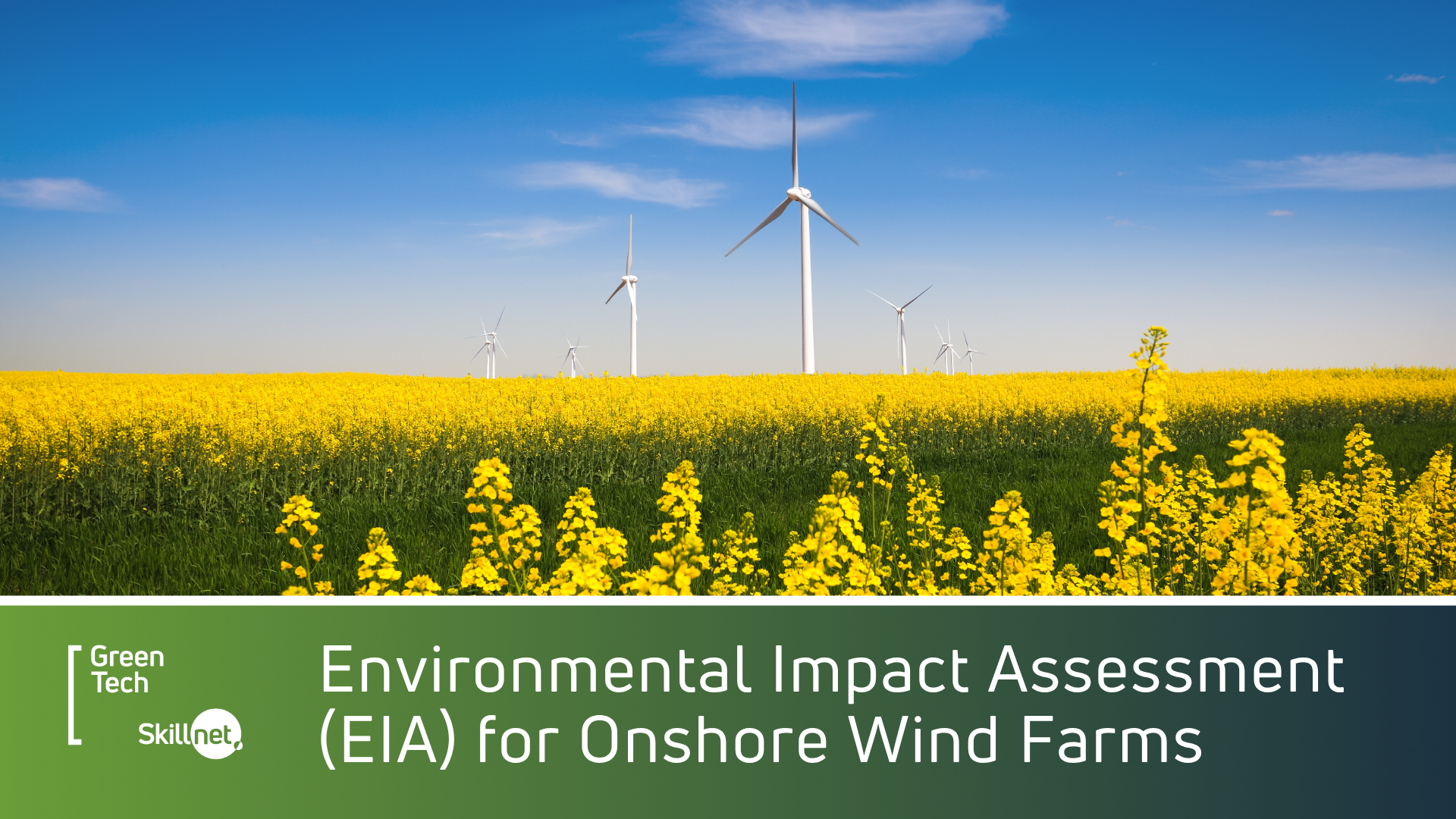


Environmental Impact Assessment (EIA) plays a vital role in delivering sustainable energy projects and meeting legal requirements. In this 8-week, Level 9 micro-credential, you’ll develop the skills to evaluate the environmental impacts of energy projects, with a focus on wind energy in Ireland.
You’ll learn how to apply EIA processes, interpret relevant Irish and EU legislation, and analyse real-world case studies to improve project outcomes. This module is ideal for professionals in the renewable energy sector who want to lead or contribute to the EIA process with confidence.
Notably, this is the first EIA micro-credential in Ireland specifically tailored for onshore wind farms, marking a significant milestone in the development of industry-specific education. This is an onshore/terrestrial course.
The course will also include an in-depth analysis of EIA case studies relevant to wind energy, offering practical insights and real-world applications to better equip participants for the challenges of assessing environmental impacts in this rapidly growing sector.
*** Applications are now open. Please check your eligibility below. If you are eligible, please proceed to make the payment. Once payment has been received, the registration link for UL will be sent. If you are ineligible or work for a semi-state company, please enquire now. ***
Grant funding comes from Skillnet Ireland through the Irish National Training fund, and, as a result, is ONLY available to residents of the Republic of Ireland who work as a sole trader, or for a private or semi-state commercial company registered in ROI. Please read Eligibility Criteria.
During this module, you will:
-
Explore the role of Environmental Impact Assessment (EIA) in the planning and delivery of renewable energy projects, particularly onshore wind developments.
-
Gain a clear understanding of Irish and EU environmental legislation and how it applies to infrastructure and energy projects.
-
Learn how to contribute to effective, evidence-based EIAs that balance environmental protection with development needs.
-
Develop key professional skills in scoping, impact analysis, mitigation planning and post-project monitoring.
Key Information
This micro-credential will be delivered online over 8 weeks through a blend of pre-recorded lectures, interactive tasks, and live sessions.
You’ll be assessed using a final report to identify and synthesise current best practice of Irish wind EIA.
Part-time considerations:
-
-
Designed for working professionals
-
Evening or recorded lectures
-
Additional prep and group work time
-
Timetable provided after registration
-
| Schedule Autumn 2026 (Week 1 begins October 12th. ) |
| Week 1: Introduction to EIA |
| Live Lecture Wednesday 14th of October 6pm (UL) |
| Week 2: EU Directives & National Legislation |
| Live Lecture Wednesday 21st. of October 6pm |
| Week 3: EIA Process, Environmental Factors and Significant Effects |
| Live Lecture Wednesday 28th. of October 6pm (UL) (Guest Lecture Elaine Dromey) |
| Week 4: Preparation of EIAR Part 1 |
| Live Lecture Wednesday 4th of November 6pm (UL) |
| Week 5: Preparation of EIAR Part 2 |
| Live Lecture Wednesday 11th of November 6pm (UL) |
| Week 6: Windfarm EIAR Case Studies |
| Live Lecture Wednesday 18th of November 6pm |
| Week 7: Reading and Recap Week |
| Live Lecture Wednesday 25th of November 6pm (UL) |
| Week 8: Assessment Week |
| Live Lecture Wednesday 2nd. of December 6pm (UL) |
- Define the Environmental Impact Assessment (EIA) and articulate its purpose.
Critically assess and interpret relevant EU Directives and Irish legislation. - Evaluate the stages in the implementation of EIA: methods for screening, scoping, impact identification and evaluation, review, monitoring, and post development auditing.
- Compare and review EIA and EIS.
- Define and assess Strategic Environmental Assessment (SEA), its objectives, and methodologies.
- Acknowledge the differences amongst legitimate stakeholder views in relation to environmental impact assessment.
- Discuss the role of the scientist in environmental impact assessment.
- Blended learning approach with asynchronous activities (i.e. Pre-recorded lectures, Micro-learning Activities, Discussion Forums, Knowledge Checks) and synchronous live events (i.e. live online sessions).
- Final report to identify and synthesise current best practice of Irish wind EIA.
This is a 6 ECTS micro-credential.
- Professionals in the Renewable Energy Sector:
- Environmental Consultants: Individuals who specialize in conducting EIAs and need to deepen their understanding of wind energy-specific assessments.
- Project Managers: Those overseeing wind farm projects and responsible for ensuring compliance with environmental regulations.
- Environmental Engineers: Engineers involved in the design and implementation of wind energy projects who need to consider environmental impacts.
- Ecologists and Biologists: Professionals focused on the impact of wind farms on wildlife and natural habitats.
- Government and Regulatory Personnel:
- Environmental Planners: Government officials or planners involved in reviewing and approving wind farm projects who need a thorough understanding of EIA processes.
- Policy Makers: Those involved in developing regulations or policies related to wind energy and environmental protection.
- Regulatory Compliance Officers: Individuals ensuring that wind farm projects comply with environmental laws and regulations.
- Other Stakeholders:
- Legal Professionals: Lawyers specializing in environmental law who advise clients on compliance with EIA requirements for wind farms.
- Developers and Investors: Those investing in or developing wind energy projects who need to understand the environmental assessment process to mitigate risks and ensure project viability.
***Applications are welcome from those who hold a degree in a relevant subject area, and/or have significant, relevant experience in the energy sector. Please note that applicants must hold a Level 8 Degree in cognitive discipline or equivalent relevant professional experience.***
Applicants who do not have English as their first language may satisfy English Language requirements:
- If your qualifications have been obtained in a country where English is an official language this will suffice
- If this is not available, the following additional documents must be provided:
- English translation of your qualification(s)/transcripts AND
- English language competency certificate
For more information on English Language requirements Click Here
All applications are assessed on a case-by-case basis.
This micro-credential can lead to the following sectors and careers:
-
Environmental consultancy and planning, including roles such as Environmental Consultant or Environmental Planner
-
Energy sector roles related to project development and regulation, including Project Manager or Energy Analyst
-
Environmental science and assessment roles, such as Environmental Scientist, Ecologist or Hydrologist
-
Further study or training in renewable energy, environmental management or EIA-related specialisms
To help you to be successful on this course:
-
Applicants should hold a bachelor’s degree (NFQ Level 8) with at least a second class honours, grade 2 (2:2) in a relevant cognitive discipline.
-
If applicants have a lower result or an unrelated qualification, they may be considered on a case-by-case basis if they can provide evidence of 3 years of experience in the energy sector. (Recognised Prior Learning).
Guidelines for your applications:
-
When applying, be sure to include the Module Code ER6421. We can’t process your application without it. You can apply for more than one module using the same application.
-
By applying, you confirm that you meet the entry requirements and can take part in the course and its assessments.
-
This course will go ahead if it meets minimum enrolment number.
-
Completing this module doesn’t guarantee you a place in a full programme. If you want to apply for a full programme, you must meet the specific entry requirements for that programme.
Elaine Dromey – Ecologist / Director at Dromey Eco Consulting Ltd
Guest Speaker
Elaine Dromey holds a BSc (Hons) Earth Science with a major in Plant Science from University College Cork, Ireland, MSc Vegetation Survey and Assessment from University of Reading, UK and an Advanced Diploma in Planning and Environmental Law from The Honorable Society of King’s Inns, Dublin. Elaine has been a full member of the Chartered Institute of Ecology and Environmental Management (CIEEM) since November 2003. Elaine sits on the CIEEM Professional Standards Committee (PSC) and provides input on matters relating to standards and industry guidance. Elaine worked as an ecological consultant, both in the UK and Ireland.
Elaine has worked on a large and diverse portfolio of renewables projects providing technical advice, preparing and reviewing EIAR chapters, Appropriate Assessment (AA) reports and Habitat and Management Plans. Elaine has an excellent understanding of international and domestic wildlife legislation, policy and recent case law particularly in Article 6(3) and 6(4) of the Habitats Directive. Elaine also has experience of engaging in consultation and negotiation with local planning authorities and key stakeholders.
Jo Wotton – Associate Director, Environmental Planning, LUC
Guest Speaker
Associate Director, Environmental Planning, LUC
Jo has over 15 years of professional experience across the private and public sectors, including project management of numerous complex EIA projects involving large multi-disciplinary teams, from feasibility through to discharge of planning conditions. Jo has managed several EIAs for onshore wind farms and energy transmission projects across Scotland and conducts independent EIA reviews on behalf of determining authorities. She has also delivered EIA training for local authorities and other agencies. Jo is passionate about the benefits that EIA can bring to a project and is involved in numerous initiatives to further EIA practice, both within LUC and through working with other agencies, including Scottish Renewables. In 2024-2025 Jo led the work of the Scottish Onshore Wind Sector Deal EIA ‘Task and Finish Group’ which resulted in the publication of Scottish Renewables guidance on streamlining EIA for onshore wind projects.