


This Green Tech Skillnet Micro Credential is co-funded by the Government of Ireland and the European Union www.eufunds.ie.
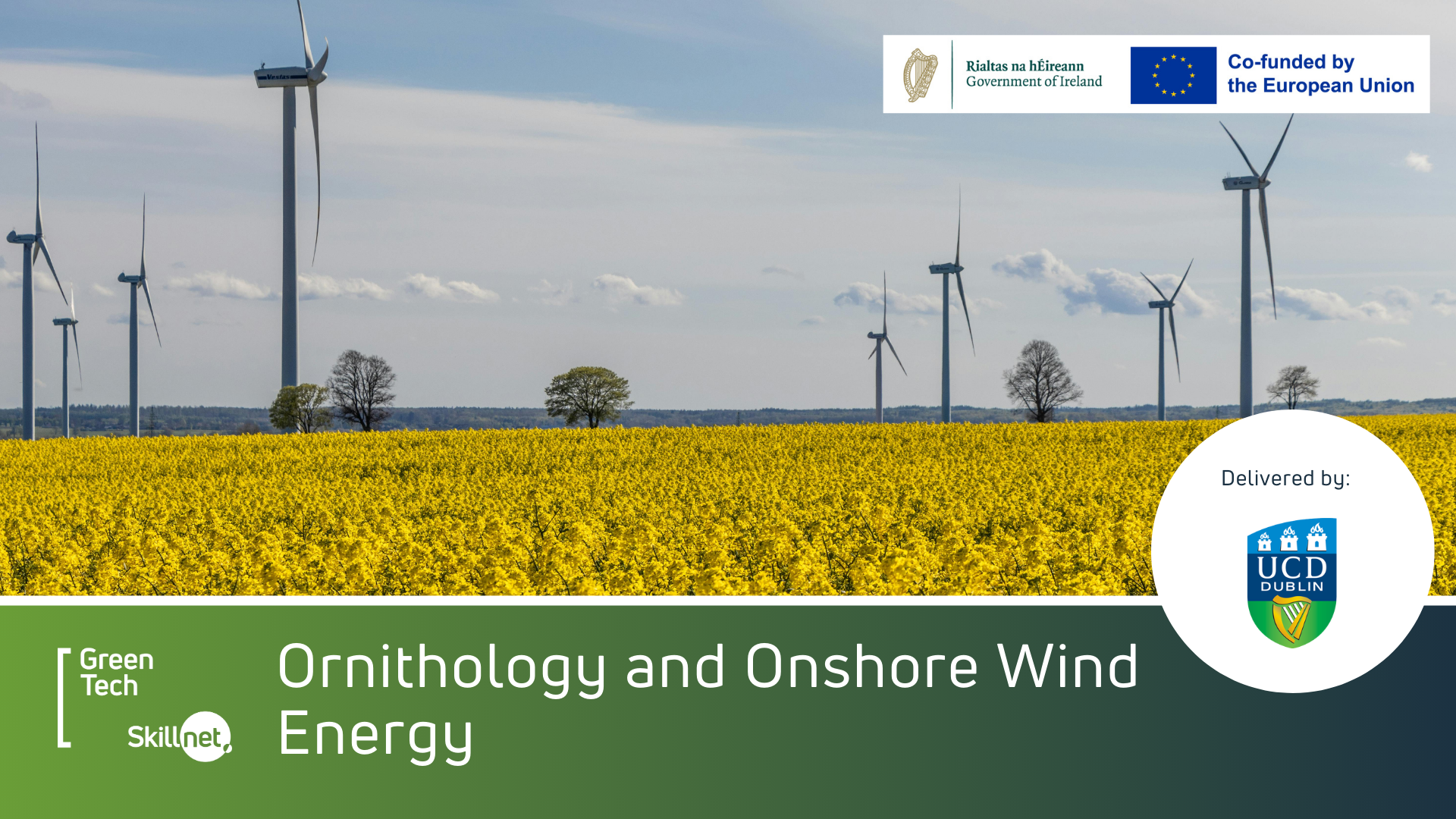
This interdisciplinary course explores the ecological impacts of onshore wind energy infrastructure on terrestrial bird populations. Students will critically examine the interactions between wind turbines, habitat alteration, and bird behaviour, with a focus on species vulnerability, collision mortality, displacement, and population-level effects. The course integrates concepts from ecology, environmental science, conservation biology, and environmental policy. Students will review and evaluate peer-reviewed literature, environmental impact assessments, and case studies from around the world with a focus on Ireland.
All funded spaces have been allocated. Enquire now to be added to the waitlist for 2027.
- Understand the direct and indirect effects of onshore wind energy on bird populations.
- Identify and monitor at risk species.
- Analyse and critique scientific studies and environmental assessments related to wind energy development.
- Apply ecological and statistical tools to assess risk and impact.
- Develop evidence-based recommendations for minimizing avian impacts of wind infrastructure.
Indicative content:
Week 1: 23rd – 27th March
- Introduction to Terrestrial Avian Ecology with Species ID
- Introduction to Bird Survey Techniques
Week 2: 30th – 3rd April
- Bird Flight Mapping and Behaviour
- Collision risk modelling
Week 3: 6th April – 10th April
- Mortality Monitoring and Collision Detection
- Habitat Loss and Displacement Effects
Week 4: 13th – 17th April
- Population-Level Impact Assessments
- Environmental Impact Assessment (EIA) for Wind Projects
Week 5: 20th – 24th April
- Monitoring and Mitigation Techniques
- Emerging Technologies and Future Directions
Field trip to Mountlucas Wind Farm and field trip to another location TBC. Focus on field reports, data collection, height estimation.
By the end of the course you will have a comprehensive overview of the bird species that can be impacted by onshore wind energy infrastructure, the potential impacts, how to measure them and how to set out monitoring all of the above in the field.
Ornithologists
Ecologists
Environmental Consultants
Environmental Advisors
Biodiversity Officers
Environmental Impact Assessment (EIA) Specialists
EIA Consultants (Wind Projects)
Wildlife Surveyors
Bird / Avian Surveyors
Environmental Project Managers
Environmental & Consenting Coordinators
Conservation Officers
Planning & Environmental Officers
Renewable Energy Environmental Specialists
Grant funding comes from Skillnet Ireland through the Irish National Training fund, and, as a result, is ONLY available to residents of the Republic of Ireland who work as a sole trader, or for a private or semi-state commercial company registered in ROI. If you are not eligible for the discount, you will still have the option to enrol by paying the full course fee. Please read Eligibility Criteria.
Dr Adam Kane
Assistant Professor at the School of Biology and Environmental Science at University College Dublin (UCD)
Dr Kane’s studies cover two main areas of research in biology – movement ecology, particularly of birds, and media portrayals of nature. He frames the results of his research in these areas in a conservation context. He is particularly interested in determining drivers of foraging behaviour and using these locations as targets for conservation action/ wildlife management.